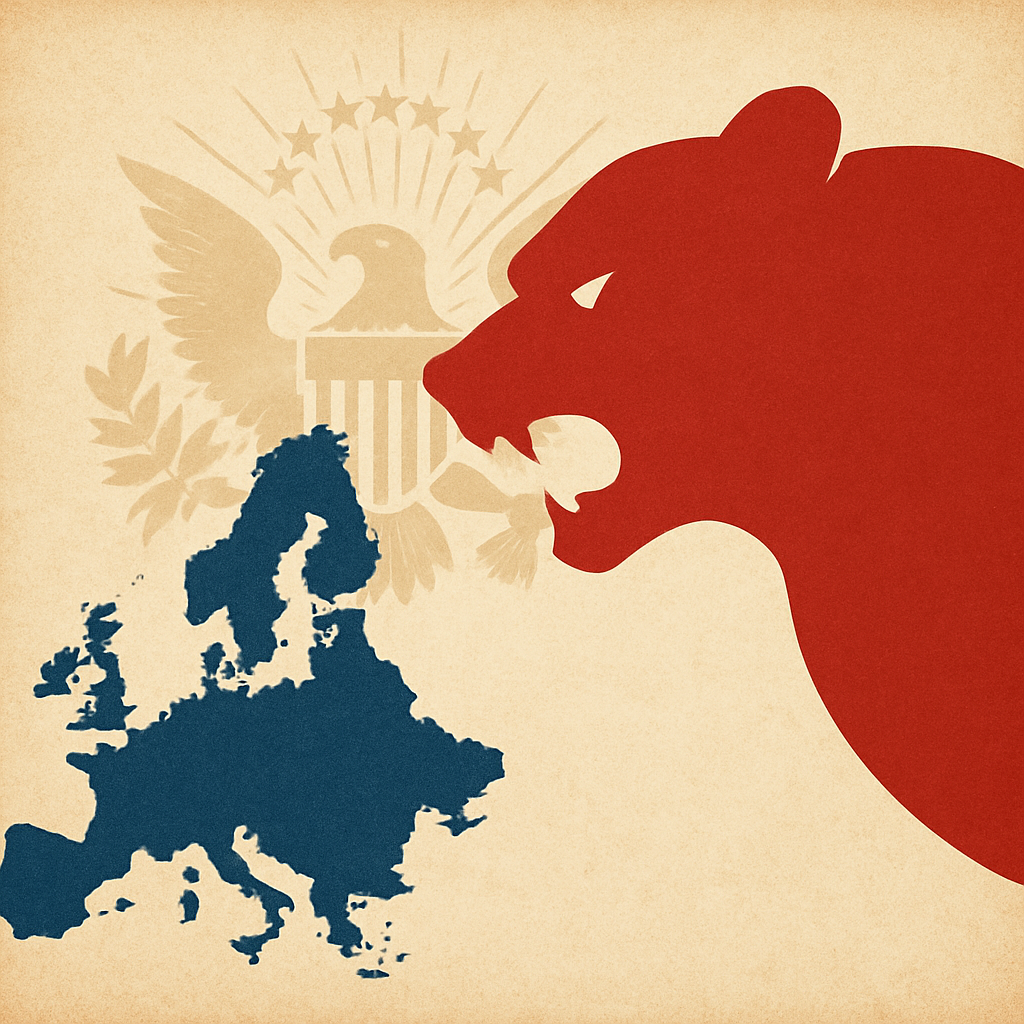
There are four parties in this war, but only two sides. Ukrainians, Russians, Americans and Europeans each have their own objectives and red lines, but the convergence of Russian and American ambitions is further consolidating the bloc formed by the European Union and Ukraine.
Firstly, Vladimir Putin does not want to rebuild the USSR. He wants to rebuild the Tsarist Empire, in which there were no national republics – Ukrainian, Baltic or Georgian – which he blames the communists for creating. Whilst purely formal as long as the Soviet regime was strong, it was these republics that exercised their constitutional right to self-determination to become independent states after the fall of the Berlin Wall. Vladimir Putin would like to bring them all back into the Russian fold today, step by step of course, and as soon as possible add territories that were once part of the empire, such as Finland or even – why not? – the part of Poland that Moscow claimed in the 19th century.
This is no secret. It has been said, and when the Russian president denies wanting to attack ‘Europe’, he is only half lying, because he does not want to extend his empire to the Atlantic coast, but to restore the borders of the tsars in order to make it the dominant force on a continent that the United States has been turning away from for two decades.
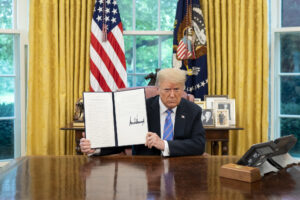
This is where his ambitions coincide with those of Donald Trump, because the American president does not merely admire Vladimir Putin’s authoritarianism. Far beyond this ideological convergence, he sees no strategic disadvantage in the Russian Empire being rebuilt and, on the contrary, would see only advantages in the disintegration of the European Union. As both an economic competitor to the United States and an obstacle to Russia’s imperial ambitions now that it has integrated a large part of the former Soviet bloc, the EU is the common adversary of Trump and Putin, a power that they both want to divide and destroy before it asserts itself as a political player on the international stage. In short, Trump and Putin’s dream is to agree at the expense of the Europeans in order to restore their countries to the status of dominant superpowers that they have lost since the end of the Cold War.
As for the Ukrainians, they are anything but blind. They are well aware that they will never be able to regain their lost territories of Crimea and Donbass until the Russian Federation eventually breaks up. Ukraine knows that this war will only end with its division. It admits this. It is preparing for it but refuses to cede to Putin lands he has not conquered and to limit Ukraine’s remaining military, political and diplomatic sovereignty.
Ukraine wants to be able to deter Russia from ever renewing its aggression, and unlike the Americans, the Europeans agree with it on this point. The countries of Central Europe do so because they fear they too will be victims of renewed Russian aggression, and those of Western Europe because they do not want to find themselves alone in the face of a new Russian Empire.
With the exception of Hungary and Slovakia, the Union has thus come to form a political entity of profound unity, aiming to establish a common defence. This is a completely new development, a turning point made all the more significant by the fact that the Europeans are actively supported by the United Kingdom and several other major democracies.
Three times already, this has enabled the Ukrainians to escape the surrender that Donald Trump would have liked to impose on them. Ukraine and the EU are holding firm, but their situation is difficult because they are caught in a vice between the Kremlin and the White House, because there will be no European defence for several years, and because American intelligence is simply indispensable to Ukraine’s defence.
This is Donald Trump’s trump card. Vladimir Putin has far more men at his disposal than Ukraine, but in this week’s umpteenth round of talks, the Ukrainians and Europeans will have had four major advantages. The Russian economy is weakening. Donald Trump’s popularity continues to decline. Unless he wins a resounding victory that allows him to proclaim himself the winner, Vladimir Putin cannot accept the minor compromises that the Americans would need to twist the Ukrainians’ arm. This is so true that he has always refused to do so until now, and Donald Trump, for his part, would be taking a big risk by openly stabbing Ukraine in the back, as the whole world would then question the credibility of the United States. The game is terribly close, but democracy has not yet lost.